20 May 2026
What Is A Micro ATM And How Does It Work
A practical guide to Micro ATM infrastructure, what it does, who it's built for, and why cooperative banks and field collection teams are adopting it rapidly.

20 May 2026
A practical guide to Micro ATM infrastructure, what it does, who it's built for, and why cooperative banks and field collection teams are adopting it rapidly.


There are parts of India where the nearest ATM is at least an hour away. Where a member of a cooperative society who needs to deposit their daily savings has to either wait for a bank visit or hand cash to someone they trust. Where a field agent collecting electricity bill payments still carries a receipt book and reconciles manually at the end of the day.
Micro ATMs exist to solve exactly this, as a proper, certified banking infrastructure built for the last mile.
A Micro ATM is a handheld, portable device that allows a trained banking agent or field operator to carry out core financial transactions, deposits, withdrawals, balance enquiries, fund transfers, and bill payments, on behalf of a bank or cooperative institution, anywhere they can operate.
It is not a scaled-down ATM in the traditional sense. There is no cash dispensing mechanism. What it does instead is authenticate the customer biometrically using their Aadhaar number, connect to the banking network, and process the transaction in real time, with a receipt generated immediately and a record maintained automatically.
The hardware and software together make this possible. The A20 and A20 FP from Access Computech serve as the hardware platform, UIDAI L1-certified biometric devices with integrated payment capability, built to handle the physical demands of field operations. The software layer, provided by ezPigmy, handles the transaction workflows, collections, reconciliation, receipt generation, and reporting that make the device genuinely useful as a banking tool rather than yet another payment terminal.
The person carrying a Micro ATM is typically a banking correspondent, a pigmy agent, or a field collection executive, someone who serves a defined set of members or customers in a specific geography. They visit homes, shops, or community points rather than waiting for customers to come to them.
In a typical field session, the operator might collect a member's recurring deposit, process a utility bill payment, accept a loan repayment, and handle a balance enquiry, all within the same visit, all on the same device. Each transaction is authenticated via Aadhaar biometric, which means the customer doesn't need to carry a passbook, a card, or remember a PIN. Their fingerprint is the credential.

Once the transaction is processed, the customer receives an SMS receipt immediately. The operator doesn't need to maintain a paper ledger, the system logs every transaction automatically, maintaining a real-time record of collections in, payments out, and net position for the day.
At the end of the field session, reconciliation happens on the backend itself. There is no manual tallying, no end-of-day paperwork, no discrepancy between what was collected and what the system shows. The data is already collected and processed in real time.
A Micro ATM running on the A20 platform with ezPigmy supports a broad range of field banking workflows:
Each of these runs on the same device, under the same authenticated session, with the same automatic record-keeping. For an operator managing fifty to a hundred members across a route, that consolidation matters significantly.
Cooperative banks and urban cooperative banks serve a membership base that is, by nature, distributed. Their members are not concentrated around branches, they are spread across localities, mohallas, and sometimes rural catchments where branch visits are infrequent.
The pigmy collection model, where agents visit members to collect small daily or weekly savings, has existed in cooperative banking for decades. It works because it meets the member where they are. The challenge has always been the operational overhead: paper receipt books, manual ledgers, end-of-day reconciliation that depends entirely on the agent's accuracy, and no real-time visibility for the institution into what is being collected in the field.
A Micro ATM infrastructure replaces the manual layer without replacing the human one. The agent still visits the member. The relationship is still local. But everything behind the interaction, authentication, transaction processing, receipts, records, reconciliation, is now handled by the system rather than by the agent's notebook.
For cooperative bank administrators, this means real-time visibility into field collections, automated reconciliation that doesn't wait for agents to return to the branch, and a clean audit trail for every transaction. For members, it means a faster, more reliable experience with their institution, and confidence that their deposit has been recorded correctly.
A Micro ATM is only as good as the two layers it runs on. Weak hardware in the field, devices that struggle with fingerprint reads, drop connectivity mid-transaction, or fail under daily operational load, undermines the entire model. Weak software, systems that don't reconcile cleanly, generate receipts unreliably, or require manual intervention to close the day, puts the burden back on the operator.
The A20 and A20 FP are built for field conditions. UIDAI L1-certified biometric authentication, integrated payment processing, and a form factor designed for daily use by operators who are not IT specialists. The devices handle the capture, the encryption, and the transaction communication, reliably, in real-world environments.
ezPigmy adds the operational intelligence on top of that foundation, managing the full lifecycle of a field collection session from the first transaction to the final reconciliation, with PhonePe-integrated UPI support for digital payments and SMS receipts that reach the customer instantly.
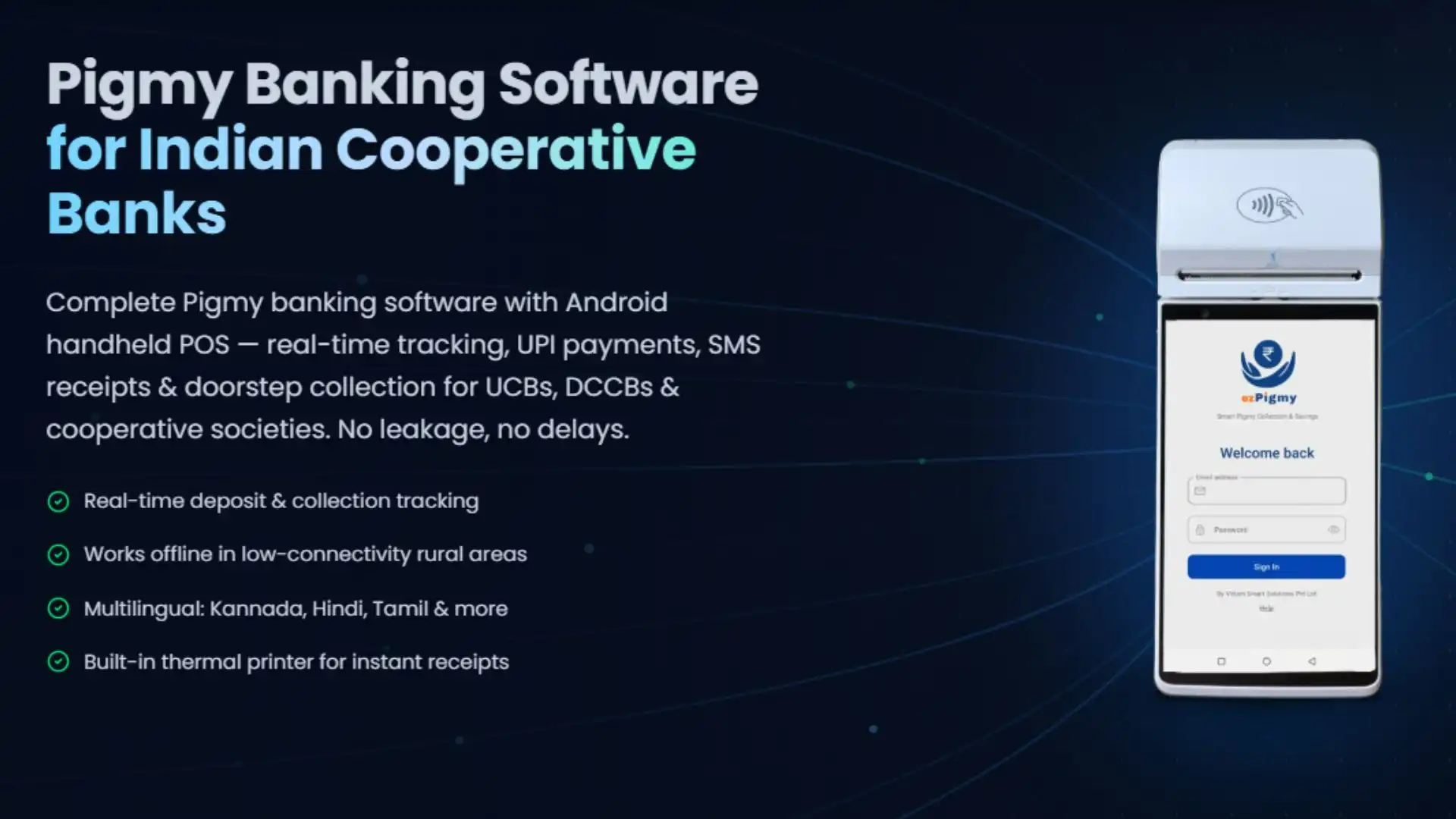
Together, the system doesn't just digitise the pigmy collection process. It makes it operationally dependable at scale, for the institution managing hundreds of agents, and for the agent managing hundreds of members.
If you'd like to understand how a Micro ATM setup maps to your cooperative bank or field collection operation, we're glad to walk you through it.