22 April 2026
Access Control In Indian Manufacturing
How modern factories are moving beyond the gate register by connecting access control, attendance, and workforce compliance in one system.
22 April 2026
How modern factories are moving beyond the gate register by connecting access control, attendance, and workforce compliance in one system.


If you walked into any large manufacturing facility in India today, you'll still find some version of the gate register. We as a populace are very used to keeping a logbook, a security guard, a stack of ID cards, and a manual process that has always worked for us.
However, these systems are not without their issues. Consider, a contractor who shouldn't be on the floor managed to bypass the manual check with a proxy. Or an entry timestamp doesn't match the shift report because one worker wanted a full day’s pay with half a day’s work.
The gate register isn't as foolproof a system as it is considered to be. And these gaps tend to broaden in ways that accumulate over time. Just multiply the above instances to take place over multiple months or years, and the direct impact on security or expenditure starts to compound.
The new age access control eliminates this dependency on human limitations, by setting up the process so seamlessly, that there remains no room for these errors to take place.
What's changing in Indian manufacturing isn't a full-scale replacement of security infrastructure. It's a more fundamental rethink of what access control is supposed to do and what it should feed into.
Modern access control in a manufacturing context isn't a single device at a single entry point. It's a connected system: biometric or card-based entry at the factory gate, zone-level access control within the facility, attendance logging tied to shift schedules, and contractor management that distinguishes between permanent employees and third-party labour.
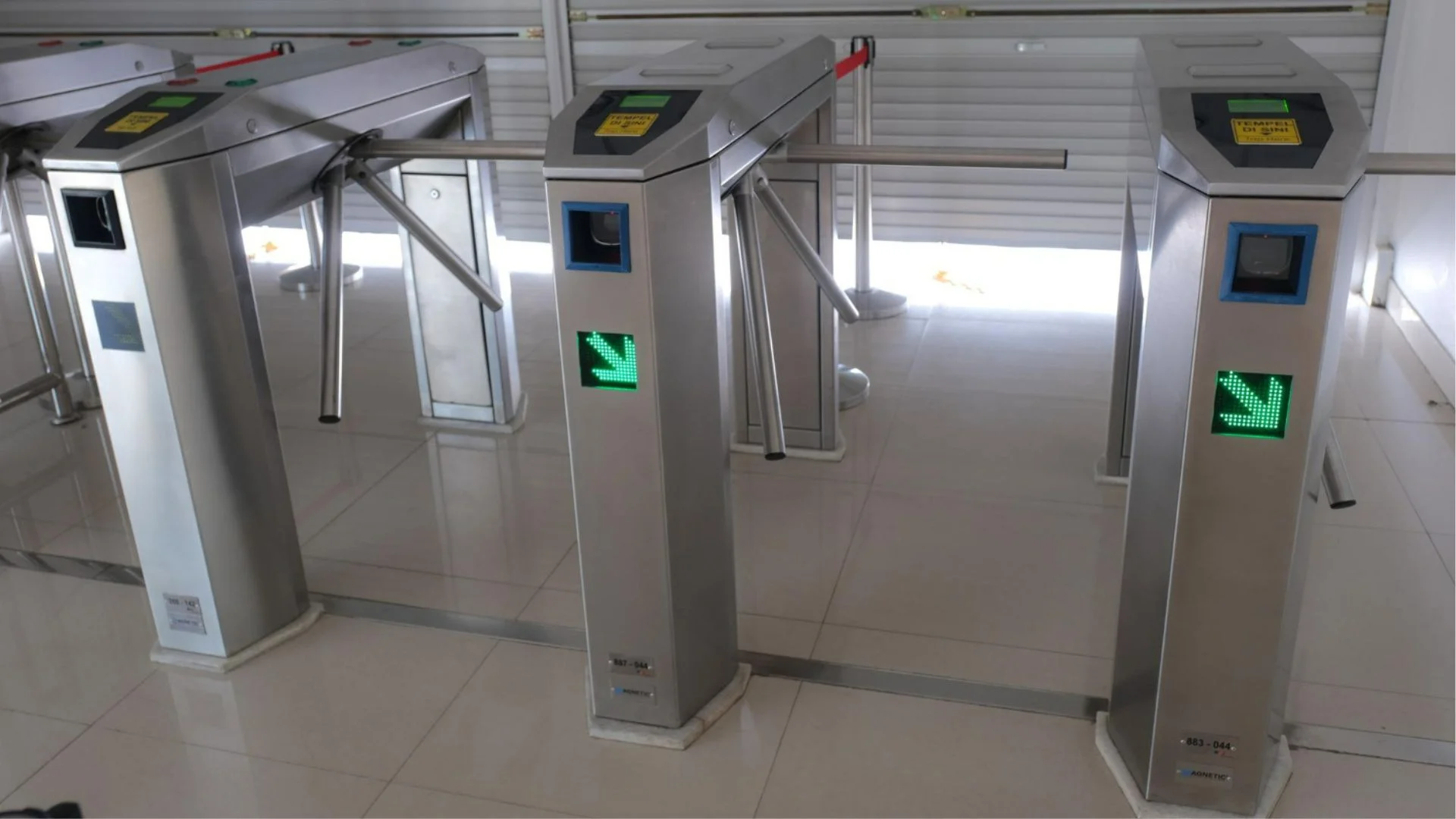
For example, the Tripod 3338 and Tripode ZK Teko handle high-traffic entry points with fast, reliable authentication and LED-guided direction control. These features become very important when you have hundreds of workers clocking in at shift change.
Or take the Flap Barrier for instance, which provides intelligent one-person entry for sensitive zones like production floors or quality control areas where unauthorised access has real operational and compliance consequences.
If vehicle access is needed at entry points, then devices such as the Straight Barrier are very capable of managing and bringing the same systematic control to movement that happens outside the main building.
Each of these is a piece of the same puzzle, but the value comes from how they connect.
Manufacturing operations in India rely heavily on fixed-term contract labour like maintenance crews, loading teams, seasonal workers, specialist technicians. Managing this workforce is where most access control systems show their limits.
A contractor who completed their engagement three months ago shouldn't still have an active access credential. A vendor's technician visiting for one day shouldn't have the same access level as a permanent floor supervisor. But in facilities running on card-based or manual systems, these situations persist because no one has a clean, real-time view of who has access to what.
But we have solved it. Access Computech's Contract Labour Management and Access System (CLMS/CLAS) addresses this directly by managing contractor onboarding, assigning time-bound access permissions, and automatically flagging or revoking credentials when an engagement ends. For factories managing dozens of contractors simultaneously, this is almost akin to a compliance requirement. And the best part is, the CLMS/CLAS seamlessly integrates multiple devices to maintain a single and easily manageable workflow.
The attendance data generated by an access control system is only useful if it integrates somewhere. In too many manufacturing facilities, the gate log and the payroll system are still two separate processes, reconciled manually at the end of the month by someone in HR who didn't design either of them.
Consider this use-case wherein the SentinelFP and FP900 are deployed at all attendance points within the facility. They feed the attendance logs directly into the Employee Attendance Recording System (EARS), generating real-time attendance records, shift-based reports, and exception alerts that integrate with downstream payroll and compliance workflows.
And when a labour inspector asks for attendance records for a specific period, the answer is a 100% transparent and ready-to-present report, not a search through logbooks.
The word "integrated" gets used loosely in enterprise technology conversations. In the context of manufacturing access control, it means something specific: that the entry gate, the zone access points within the facility, the attendance record, the contractor credential database, and the compliance reporting system are all reading from and writing to the same source of truth.
When a labour inspector asks for attendance records for a specific period and workforce category, the answer is a report generated in minutes, not a search through physical logbooks or a manual extract from three different systems. When a contractor's engagement ends, their access expires automatically rather than waiting for someone to remember to deactivate it.
When an anomaly occurs, such as an employee accessing a restricted zone, an unusual entry time, or a credential being used at an unexpected location, the system surfaces it rather than burying it in a log no one reviews.
This is the actual operational value of modern access control in manufacturing. Not any individual device, but the connected system those devices enable, one where security, workforce management, and compliance are no longer separate administrative burdens but outputs of the same infrastructure.
For facilities at any stage of this journey, whether you're replacing a manual system entirely or looking to connect infrastructure you already have, the conversation is worth having sooner rather than later.
If you'd like to see how Access Computech's access control and workforce identity systems map to your facility's requirements, we're glad to walk you through it.